Picture
When children try to dress like their parents, it’s often cute. When teenagers try to emulate rock stars, it’s often bizarre. When adults try to imitate their folk heroes, it’s often embarrassing.

Ever since the mass media began enabling fame for ministry leaders, adoring church people have scurried to emulate their heroes. The result has been a wave of copycat terms and behaviors–repeated not because they make sense, but because they’re used by the cool and the famous.


Here’s a sampling of ministry me-too-isms:
  1. When you preach, sit on a stool.
  2. But don’t preach. Give a message.
  3. Call yourself a “communicator.”
  4. Name yourself the “lead pastor.”
  5. Don’t love people. Love ON people.
  6. “Press in.” (Don’t know why.)
  7. Call the worship location a “campus.” (Even if it’s in a jail or on the web.)
  8. Refer to teenagers as “students.” (But don’t use the “student” word for elementary school students or college students. They’re not “students.”)
  9. Dispatch men in little orange vests to direct traffic in the parking lot.
  10. Wear a golf shirt or hawaiian shirt when you preach.  Make sure it is untucked.

I guess it’s all scriptural. “Ye are . . . a peculiar people.” (1 Peter 2:9)

What would you add to the copycat list?


This post was written by Thom Schultz.  You can find the original post here:  http://holysoup.com/2013/05/15/9-ways-to-me-too-your-ministry-heroes/

BE HOLY.
BE A MAN.


Picture
“Our church has the best youth ministry in town.”

“Everybody knows we offer the best children’s ministry in the city.”

“Our vision is to be the best church in the area.”

Over the last ten years I’ve heard statements like these with increasing frequency. Is this a good thing? Does our desire to serve God with excellence naturally lead us to want to be the best in town? Is the “best” classification the most honorable way to measure our success and effectiveness?

Most people probably view the quest for best as a helpful ambition. Driving to be better and better, at any endeavor, raises the level of quality for all. Right? Competition makes everyone better. Right? In many ways, that’s true.

But what’s necessary to be “best”? In any competitive field, in order to have winners you must have losers. In order to be best, you must conquer the others.

And that’s where the quest for best begins to turn ugly, especially in the church.

In the church, this spirit of bestfulness and competitiveness leads to pridefulness. This has not gone unnoticed by the public. A non-churched mom I interviewed said, “Churches today just want to be bigger and better than the next one. That’s not what church is supposed to be about.”

Yet, the quest for best seems intoxicating. Church gurus advise congregations to find something they can be best at in the community. “What makes you stand out among the others?” they ask. The trouble is, we’re not called to stand out. We’re called to stand behind.

In Mark 9 we see the disciples arguing about who stood out as the best disciple. Jesus confronted their quest for best. He said, “Anyone who wants to be first must be the very last, and the servant of all.” In other words, we’re not called to stand out. We’re called to stand behind those we’re called to serve.

If a church is not called to be the best in town, what is it called to be? It’s called to serve. Humbly. It’s called to touch lives with God’s love, one by one. It’s called to be faithful where God has placed it.

No disciple is called to conquer the other disciples in a quest to be best.

Jesus illustrated and summed up his lesson on humble servanthood by picking up one small child and urging his disciples to do the same, to faithfully welcome the small.

It’s not the kind of pursuit that will jetison a church to anybody’s Best 100 list.


This post was written by Thom Schultz.  You can find the original post here:  http://holysoup.com/2013/05/01/to-become-the-best-church-in-town/


BE HOLY.
BE A MAN.


Picture
Men who struggle with sexual temptation are especially vulnerable at church.  One would think that church would be the one place a man could be safe and free from temptation.  Not so.  As the weather is warming, people are wearing more comfortable clothing.  Some of that clothing is fairly revealing, even in the church.

I was a camp counselor and we were having a great worship time with our preteen campers.  However, up front, two backup singers (they were camp counselors as well) were helping the worship leader by moving in time with the music (some people would call it choreography, others would call it dancing).  With their movement, certain body parts were also moving and it was very noticeable.  Being a normal  man, I was distracted from my worship by such movement.  Afterwards, I overheard a couple of the preteens boys in a discussion about how these two women looked.  It was obvious that I wasn't the only male that was stimulated...

Men whom I have counseled have told me similar stories.  They become stimulated, and some even become triggered by such activity in the church.   Their mind wanders away from worship and often this stimulation leads to physically acting out once they leave church.  Not only do some become triggered by viewing worship leaders but sometimes they also become stimulated by the way that some women dress in the church.  If they attend a church that "hugs," these men may also be triggered by such activity.

These men need the strength that comes with corporate worship but it often backfires for them.

How does a man who is addicted to sexual activity keep himself from becoming triggered when he goes to church?  This is an extremely difficult thing for such men to work thru.  There are no easy answers and it takes real work to follow thru with some of these ideas:

1 - Don't sit up front or where you can see the worship leaders
2 - Or sit close to the front behind a large person who will block your view (that way you won't see the women in the congregation nor the women up front)
3 - Close your eyes when you are singing
4 - Concentrate on the Creator rather than the creation
5 - Come late to the service so that you miss the worship time
6 - Consider going to a church that does not have such stimulating activity
7 - Sit with a male friend who knows of your struggles who will help you stay focused and not let you look around and who will pray for you while in church
8 - Talk to your pastor about your struggles and ask for assistance/ideas 
9 - Join an accountability group and be honest about your thoughts during church and also pray about your mutual struggles.

These ideas are very hard to do and take much prayer, much mental discipline and the empowerment of the Holy Spirit.  

The answer is not to just make sure that women dress correctly. In case you didn't know, in churches that have organs, many have a screen so that you cannot see the organist's feet.  This is done because it used to be too sensual for men to see the organist's naked foot.  So, policing what women in the church wear is not the answer.  

If you are a pastor, worship leader, or someone in a position of authority in your church, I would encourage you to spend some time thinking and praying about your church and what kinds of messages your church may send to people who struggle with sexual sin.    Ask God to give you wisdom so that your church is healthy and not a hindrance.

BE HOLY.
BE A MAN.


Picture
ONE of the most striking scientific discoveries about religion in recent years is that going to church weekly is good for you. Religious attendance — at least, religiosity — boosts the immune system and decreases blood pressure. It may add as much as two to three years to your life. The reason for this is not entirely clear.

Social support is no doubt part of the story. At the evangelical churches I’ve studied as an anthropologist, people really did seem to look out for one another. They showed up with dinner when friends were sick and sat to talk with them when they were unhappy. The help was sometimes surprisingly concrete. Perhaps a third of the church members belonged to small groups that met weekly to talk about the Bible and their lives. One evening, a young woman in a group I joined began to cry. Her dentist had told her that she needed a $1,500 procedure, and she didn’t have the money. To my amazement, our small group — most of them students — simply covered the cost, by anonymous donation. A study conducted in North Carolina found that frequent churchgoers had larger social networks, with more contact with, more affection for, and more kinds of social support from those people than their unchurched counterparts. And we know that social support is directly tied to better health.

Healthy behavior is no doubt another part. Certainly many churchgoers struggle with behaviors they would like to change, but on average, regular church attendees drink less, smoke less, use fewer recreational drugs and are less sexually promiscuous than others.

That tallies with my own observations. At a church I studied in Southern California, the standard conversion story seemed to tell of finding God and never taking methamphetamine again. (One woman told me that while cooking her dose, she set off an explosion in her father’s apartment and blew out his sliding glass doors. She said to me, “I knew that God was trying to tell me I was going the wrong way.”) In my next church, I remember sitting in a house group listening to a woman talk about an addiction she could not break. I assumed that she was talking about her own struggle with methamphetamine. It turned out that she thought she read too many novels.

Yet I think there may be another factor. Any faith demands that you experience the world as more than just what is material and observable. This does not mean that God is imaginary, but that because God is immaterial, those of faith must use their imaginations to represent God. To know God in an evangelical church, you must experience what can only be imagined as real, and you must also experience it as good.

I want to suggest that this is a skill and that it can be learned. We can call it absorption: the capacity to be caught up in your imagination, in a way you enjoy. What I saw in church as an anthropological observer was that people were encouraged to listen to God in their minds, but only to pay attention to mental experiences that were in accord with what they took to be God’s character, which they took to be good. I saw that people were able to learn to experience God in this way, and that those who were able to experience a loving God vividly were healthier — at least, as judged by a standardized psychiatric scale. Increasingly, other studies bear out this observation that the capacity to imagine a loving God vividly leads to better health.

For example, in one study, when God was experienced as remote or not loving, the more someone prayed, the more psychiatric distress she seemed to have; when God was experienced as close and intimate, the more someone prayed, the less ill he was. In another study, at a private Christian college in Southern California, the positive quality of an attachment to God significantly decreased stress and did so more effectively than the quality of the person’s relationships with other people.

Eventually, this may teach us how to harness the “placebo” effect — a terrible word, because it suggests an absence of intervention rather than the presence of a healing mechanism that depends neither on pharmaceuticals nor on surgery. We do not understand the placebo effect, but we know it is real. That is, we have increasingly better evidence that what anthropologists would call “symbolic healing” has real physical effects on the body. At the heart of some of these mysterious effects may be the capacity to trust that what can only be imagined may be real, and be good.

But not everyone benefits from symbolic healing. Earlier this month, the youngest son of the famed pastor Rick Warren took his own life. We know few details, but the loss reminds us that to feel despair when you want to feel God’s love can worsen the sense of alienation. We urgently need more research on the relationship between mental illness and religion, not only so that we understand that relationship more intimately — the ways in which they are linked and different — but to lower the shame for those who are religious and nonetheless need to reach out for other care.

This post was written by T. M. Luhrmann, a professor of anthropology at Stanford and the author of “When God Talks Back: Understanding the American Evangelical Relationship With God."  For the original post with comments, go to:  http://www.nytimes.com/2013/04/21/opinion/sunday/luhrmann-why-going-to-church-is-good-for-you.html?_r=1&


Picture
Last month I heard a prominent leader of a national movement of mostly white Christians give a talk in which he compared his group’s beliefs to various other Christian groups (including more ethnically-diverse groups). While extolling the virtues of his group’s beliefs he proudly proclaimed, “We have the best version of the Gospel.” Now I’m not interested in busting any one person’s (or group’s) chops, and in fact, I give him a lot of credit for saying publicly what many of us say behind closed doors and in our hearts.  But as a minority group member sitting in the audience, I found his statement to be unfriendly to diverse voices.

Most blatantly, the statement violates the metaphor of the interdependent and multifaceted body of Christ.  How can a gospel that is mostly (if not entirely) interpreted and articulated by a homogenous group of people (in this case, white, well-educated males) be the “best version”? But in a more subtle way, his statement sent a clear and powerful message to all of the diverse people in the room (e.g., women, people of color, people without advanced degrees, etc.). No need to join our movement; we don’t need diverse voices. We’ve already got the best version of the Gospel and we only needed white, well-educated men to figure it out. Diverse people need not apply.

Again, this guy simply said aloud what a lot of other people say privately or inwardly. But whether we make such audacious statements aloud or not, people of all cultures run the risk of alienating diverse people if they mistakenly believe that their homogenous group has basically figured out how to think, worship and live.

We might say we want diverse people to participate in our group but we are often too enamored with our own culture (e.g., our version of the Gospel) to invite diverse people to influence it. Rather, than actively seeking input from diverse people, we require them to assimilate to and bow down to the dominant culture. This approach might work to attract people who look diverse (in terms of race/ethnicity, etc.) but it will repel people who offer culturally-diverse perspectives.

Non-majority members who attempt to exert diverse cultural influence are often ignored — or worse, silenced and shunned. How dare they try to change our little utopian culture? we ask ourselves. How dare they challenge our perfect version of the Gospel? HOW DARE THEY?

I think we adopt a defensive and uninviting posture towards diverse others when we idolize our cultural group identity. When this happens, minority group members are not truly invited to participate in the community as valuable members of the all-inclusive we. Rather, they are invited to participate in the group as them—subordinate group members and second-class citizens.

Is cultural idolatry the source of this problem? If so, how do we avoid it?  If not, what is the problem?


This post was written by Cristena Cleveland.  For the original post with comments, go to:  http://www.christenacleveland.com/2013/05/we-have-the-best-version-of-the-gospel-diversity-repellent/


BE HOLY.
BE A MAN.


Picture
On a recent Sunday morning, I was having breakfast when I turned on my t.v. to watch a well-known local church’s broadcast.  As I came to the right channel, I was greeted by the image of stage lights and a multi-piece band.  Instead of what would normally be an opening praise song, the band started into the Bon Jovi 80′s classic, You Give Love a Bad Name.  After the initial shock wore off, I double checked the channel I was on.  Sure enough, this was the church service I was looking for.  As the song finished, a member of the pastoral staff came out from behind the stage.  After making a somewhat crude joke about hot flashes, he announced that the morning’s message would be on arguments in marriage.  The staff member exited the stage while the band started into a worship song.  With the band leading the church in two worship songs, I was left asking myself, “What in the world just happened?”

In a way, it is understandable what the church was trying to do.  They wanted to get the congregation focused on the message by using a song containing the message’s theme.  It is a common practice that many churches utilize today, traditional and contemporary alike.  In either case, the music is tied in with the sermon topic to provide a theme for that day’s service.  This method of planning worship services certainly has benefits, including the reinforcement of the sermon.  However, there is an inherent danger in using this method every time a worship service is planned.

The TV broadcast mentioned above demonstrates an extreme in worship planning.  This church is somewhat known for using secular songs related to the sermon as a call to worship.  In this instance, they turned to a rock song whose lyrics speak of being hurt in a relationship.  This song’s theme directly related to the sermon topic for that morning.  While the very thought of a secular song being used in a worship gathering is enough to cause controversy in some circles, the danger this congregation is flirting with goes much deeper than the use of one song in a service.  This church was so focused on reinforcing the message that, while externally polished, the intrinsic quality of worship was sacrificed.  They did not make time for prayer in their service and placed little emphasis on Holy Communion.

People are intrinsically designed to connect with God on many levels.  Scores of people have been impacted through the centuries by hearing powerful sermons and homilies.  Additionally, innumerable hearts have been led into God’s presence through mighty hymns and contemporary worship songs.  These hymns and songs have been the catalyst for outpourings of the heart onto God and have fostered many times of prayer.  In worship, there must be a balance of what I call the Spoken Word and the Living Word.  The Spoken Word is hearing a sermon/message/homily preached from the Scriptures and receiving from it.  Some traditions would call this, “The Word Proclaimed.”  The Living Word consists of coming to God in prayer, singing from the heart, and taking part in Holy Communion, e.g. the “hands-on” part of worship.  This would be the more experiential part of worship where a congregation would be actively participating in the service.

 A healthy church knows what it is to give equal weight to the Spoken and Living Word.  A vital church also knows that there are instances when the Holy Spirit will direct that one be given more emphasis, e.g. more time, over the other.  However, churches that consistently give one more priority over the other run the risk of not only robbing their members of a full worship experience in the presence of God but also presenting an incomplete picture of Christian worship to unbelievers.  The fact that we believe in and worship a God that is alive is what separates us as believers from other world religions.  How we worship our Lord communicates to the world what we believe.  A church that has unbalanced worship conveys its lack of spiritual depth, and no matter how flashy we try to be in our church services, unbelievers are not as spiritually and intuitively naïve as we sometimes think they are.  They can tell when something is not right within the church walls, and they will run from it.  People are looking for something more than another message to tickle their ears.  They want something that is real and that they can experience for themselves.  A church that focuses only on its sermons robs people of additional ways to encounter the Living God and also robs God of other ways to speak to people.  Going back to the church mentioned above, their use of a secular song at the beginning of their service took time away from the opportunities to commune with God through prayer or worship music.  Because they desired to emphasize the Spoken Word, the Living Word suffered by having reduced time.

Let me conclude by posing this:  what is the first question you ask when you plan worship?  Is it, “What is the sermon about this week?”  Are all aspects of the worship service being consistently and intentionally united with that week’s sermon topic?  Are the prayers prewritten to match the message?  Are all the opening and closing hymns/praise songs being chosen simply because the title/lyrics relate to the sermon?  Or is the first question asked, “Lord, how should we worship you this week?”  Is substantial time being spent in prayer over what hymns/songs to use?  Is there a time of spontaneous prayer set aside to allow the Holy Spirit to direct the hearts of those in attendance?  Your congregation, and even the entire world, depends on the first question asked in worship planning and how it is answered.  May we all have the spiritual sensitivity and courage to ask the right question and follow the Lord in our worship no matter where He may lead.


This post was written by Chase Franklin of Seedbed.  For the original post with comments, go to:  http://seedbed.com/feed/unbalanced-worship-overemphasizing-the-sermon/


BE HOLY.
BE A MAN.


Picture
Several years ago, I got into a debate with a close friend and the conversation went quickly south. What began as a discussion about our theological and political differences ended up in a shouting match in which each person's character was called into question.

I went into the argument with a "win-at-all-costs" mentality. Winning a disagreement was the only way I knew how to disagree, but what I lost wasn't worth the victory. I said plenty of things I didn't mean. As the saying goes, "I won the battle, but lost the war." And lost a great friend in the process. We haven’t spoken since.

I may have won the debate, but it wasn’t worth the cost.

We’re never going to agree with everyone we come in contact with, but we must learn how to disagree in a way that honors Christ and His body.

Disagreement is an increasing norm in our lives, but we're marginally equipped. It's much easier to post disparaging remarks on Facebook, Twitter, blogs and news articles. Digital disagreement allows us to hide behind a screen.

Just take a sampling of the Christian blogosphere, where heated debates on who gets into heaven, the biblical role of women and gay marriage, just to name a few, are commonplace. Spend time scrolling through comments where any of these discussions take place and you'll immediately lose your faith in humanity.

All of this painfully illuminates the question: Why can't Christians disagree well? Why are we so comfortable tarnishing the name of Jesus—whom we all call “Lord”—just so we can win the argument?

Christians spend much of their time focused on how to engage the un-Christian world around them—and rightfully so. Yet in doing so, we sometimes lose our ability to navigate conversations and relationships with our own brothers and sisters.

John didn't hold anything back when he said: "By this everyone will know that you are my disciples, if you love one another" (John 13:35). We usually apply this to our relationship with unbelievers, but loving “one another” in and amongst our own is an incredible witness as well—for better or for worse. So how can we turn this around? What do we need to do in order to disagree with our brothers and sisters in love.

First, we need to understand that the underlying theme that allows for disagreement to happen in a healthy way is emotional intelligence. Emotional intelligence can be simply defined as seeking to understand before being understood. It's human nature to fight for your supposed “right” to an opinion and your supposed “right” to be heard. But the reigning mark of our faith is not holding on to our personal rights, but offering our Christ-reflective unconditional love. It's easier to hoard the opportunity to push someone else down than to sacrifice your right to be heard. But to uphold the name of love, this is often the harder, better way.

Emotional intelligence is sacrificing your rights in order to care for others. This is deeply rooted in the Christian faith: "In humility value others above yourselves" (Philippians 2:3). By focusing only on yourself—your opinion, your agenda, your perspective—you shrink the world. Your problems become the lens you see everything through. You isolate yourself from a world looking for attention, love and human kindness. You cannot care for others when the world revolves around you. And you cannot build the Church body if all you are concerned about is yourself.

Yet in focusing on understanding the other, in an intentional act of love, your world expands. By seeking to understand before being understood, "our own problems drift to the periphery of the mind and so seem smaller, and we increase our capacity for connection—or compassionate action," says psychologist Daniel Goleman in Social Intelligence: The New Science of Human Relationships.

Just like in any family, conflict among Christians will never go away. But when we learn how to seek understanding before being understood, we can begin to have healthy disagreements.

We can learn to focus on areas of agreement over areas of disagreement. And perhaps then, we can restore our reputation of love.


This post was written by Tyler Braun of Relevant Magazine.  For the original post with comments, go to:  http://www.relevantmagazine.com/god/church/why-dont-christians-play-nice


BE HOLY.
BE A MAN.


Picture
Picking worship songs for your church or worship gathering is an important task. In a previous post, I argued that we need to start to think about how we choose songs with a long-term vision of what happens when we gather together. The things we sing shape how we view God and what it means to live as the people of God. Our song choices need to function more like a grammar for the faith and less like sacred karaoke; choosing better songs will hopefully lead to a people who are better shaped by and better proclaim the good news of Jesus Christ. 

So how do we pick better songs? Or how do we know if a new song is worth singing together? Today, I want to offer one of the questions I use to filter out what is better from what may not be: Who is doing what in this song? I know- what horrible phrasing and what an awkward question, right? Well, this is how I start to think about something grammatical people call agency. When studying the grammar of a sentence, the agent is the initiator of the action of the phrase or sentence. Agency is about who is doing what is being done in a text. Where there are verbs, there is agency, for every doing is linked to a do-er. 

Let’s take a fairly popular worship song and look at agency in its lyrics. In Tim Hughes’ “Here I Am To Worship,” the opening line of the chorus reads:

Here I am to worship,
Here I am to bow down,
Here I am to say that You’re my God.


In these lines, the agent is the “I” who is singing. “I” am the one who is acting, who is worshipping, bowing down, and saying what I then say. Similarly, in the first verse:

Light of the world,
You stepped out into darkness-
Opened my eyes,
Set me free.


The agent who stepped out, opened and set “me” free is God, or more specifically Christ, as these lyrics reference the Incarnation. There are many songs that we sing in churches that name who God is or who we are (we call those stative verbs), but even stative verbs have agency: If you claim, “Jesus is Lord”, the verb is still referring to Jesus (the agent) who is in a state of Lordship. So every song we sing has verbs in them, and the verbs point to the do-ers of the actions they name. 

What does this grammar talk have to do with picking worship songs?  Stick with me…

The gospel, or good news, of Jesus Christ centers on the actions that God took to bring salvation to us all. Paul calls the gospel, “the power of God for salvation to everyone who believes” (Rom 1:16). The Father sends the Son, in the power of the Spirit, and the Son willingly lays his life down to atone for our sin, is raised, ascends, and will return to redeem his people and the entire creation (a brief synopsis, I know). Notice how all of the verbs in the gospel have God as their agent. Why? Because he is the author and perfecter of our faith. He has acted, and we respond to his grace by his grace. 

With this in mind, I firmly believe that songs that lean more on God as the agent in their lyrics are better for the church because they better reflect the agency we find in the gospel. When you listen to a new song and it is more about what I or we are doing than what Christ has done/is doing/will do, the song should seem off-balance in light of the agency of the good news. There is definitely a place for songs and lines of response (and I will talk about that soon), but as worship leaders whose song choices shape the thoughts and hearts of those who join us in song, we must first and primarily name who God is and what God has done, for in God and his actions we find the power of God for salvation to everyone who believes, and that includes the people singing in our church. 

So when you listen to that new Cool Guy Worship Collective album, pay attention to the verbs. Who is the primary do-er in this song? Who is acting, and what actions are being named? Live by this rule when choosing songs: a song with heavy God-agency will always be healthier for your church than a song with heavy us-agency. The more the saving actions of God are named, the more likely the song will shape your church into the redeemed people the good news redeems by the power of the Spirit. 

This post was written by Drew Causey.  For the original post with comments, go to:  http://exchangedliving.com/post/48779369196/picking-worship-songs-101-gods-love-my-love


BE HOLY.
BE A MAN.


Picture
I’m a member of Alaska’s largest church. It’s a lot like every other megachurch. We meet in a cavernous, windowless room with stage lighting and two huge projection screens. We’re led by a rock band and a casually dressed pastor. The service lasts exactly 75 minutes. Our church draws a large crowd that attends sporadically. There’s a relatively small, highly committed core of members that keeps the machine going.

I like my church. But it’s in Anchorage, 26 miles from my house. So my wife and I occasionally worship at a small traditional church in our little town of Chugiak. (Let’s call it St. Mark’s)

We’ve been enjoying our Sundays at St. Mark’s. The richness and rigor of the liturgy is refreshing after years of seeker-sensitive services. It’s an eight-course meal, carefully measured out for us by church fathers – confession, forgiveness, praise, instruction, communion, giving, fellowship and benediction. It’s like a spiritual multivitamin in an easy-to-swallow, hour-long pill.

St. Mark’s has a lot going for it. The people are friendly, but not overly so. There is a healthy number of kids and young adults. The facility is well kept. The sermons are insightful. We love the depth of the hymns – and the people sing robustly (as opposed to most megachurches where very few people sing). It takes my wife back to the 100-member churches of her youth.

But last Sunday was different. Once a month, this little church does a contemporary service. Gina and I were surprised – unpleasantly so.

We arrived to find the pastor without his clerical robe. A projection screen had been lowered in front of the organ pipes. We sang praise choruses instead of hymns, led by a solo guitarist who had trouble keeping the beat. The congregation did not seem to know the songs, so they sang tentatively. On a positive note, the sermon was good as usual, and the pastor skillfully used PowerPoint slides to reinforce his message.

But on balance, the overall quality of the service was not up to par. Had this been our first Sunday at St. Mark’s it’s unlikely we would have returned.

So what went wrong? This little church was trying to be something it’s not.

St. Mark’s is a traditional church. And it’s very good at being a traditional church. But it’s a lousy contemporary church.

It’s an article of faith these days that contemporary worship is the way to go if you want your church to grow. Thousands of churches will be planted this year – and every one will offer contemporary worship. Hymns are out – love songs to Jesus are in.

Traditional churches have seen young believers flocking to megachurches, so naturally they want to get in on the growth. But this is foolish. Traditional churches lack the musical depth, computer controlled lighting and sound equipment that are needed to generate the “praise-gasm” that young believers associate with God. Rock music seems out of place in a brightly lit chapel a communion table and stained glass.

People come to church to encounter God. A good worship service is transcendent; it helps people detach from this present world to connect with the divine. But when traditional churches try to be contemporary it usually comes across as forced, stilted or artificial. This dissonance jerks people back into the mundane world. Worshippers focus on the distraction instead of the Lord.

So here’s my advice to every church: be who you are. Do what you do well – and do it over and over. If you want to innovate, do so within the bounds of your culture.

Radio stations understand this princple. You won’t find the local pop music station playing the occasional Beethoven concerto. Nor will the country music station spin Lil’ Wayne’s latest rap record. Our local “Mix” radio station plays a variety of songs – but they’re all within the same genre – familiar pop/rock hits of the past 30 years.

If your church is big enough to offer two services, it might make sense to designate one a “traditional service” and the other a “contemporary one.” But if you offer just one service, stick with what you do best.

What has this got to do with men? Guys appreciate a quality worship service — but they are not very forgiving of anything hokey or half-baked. If guys want contemporary worship, they’ll go to a megachurch. Meanwhile, I firmly believe there’s still a market for traditional worship — even among the young — if it’s done in Spirit and in Truth.


This post was written by David Murrow.  For the original post, go to:  http://www.patheos.com/blogs/afewgrownmen/2013/04/why-traditional-churches-should-stick-with-traditional-worship/


BE HOLY.
BE A MAN.


Picture
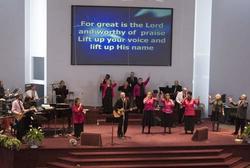
It happened again yesterday. I attended one of those hip, contemporary churches — and almost no one sang. Worshippers stood obediently as the band rocked out, the smoke machine belched and lights flashed. Lyrics were projected on the screen, but almost no one sang them. A few women were trying, but I saw only one male (other than the worship leader) making the attempt.

Last month I blogged, “Have Christians Stopped Singing?” I did some research, and learned that congregational singing has ebbed and flowed over the centuries. It reached a high tide when I was a young man – but that tide may be going out again. And that could be bad news for men.

First, a very quick history of congregational singing.

Before the Reformation, laypersons were not allowed to sing in church. Sacred music was performed by professionals (priests and cantors), played on complex instruments (pipe organs), and sung in an obscure language (Latin).

Reformers gave worship back to the people, in the form of congregational singing. They composed simple tunes with lyrics that people could easily memorize. Some of the tunes came out of local taverns.

A technological advance – the printing press – led to an explosion of congregational singing. The first hymnal was printed in 1532, and soon a few dozen hymns became standards across Christendom. Hymnals slowly grew over the next four centuries. By the mid 20th century every Protestant church had a hymnal of about 1000 songs, 250 of which were regularly sung. In the church of my youth, everyone picked up a hymnal and sang every verse of every song.

About a decade ago, a new technological advance – the computer controlled projection screen – entered America’s sanctuaries. Suddenly churches could project song lyrics for all to see. Hymnals became obsolete. No longer were Christians limited to 1,000 songs handed down by our elders.

At first, churches simply projected the songs everyone knew – hymns and a few simple praise songs that had come out of the Jesus Movement. People sang robustly.

But that began to change about three years ago. Worship leaders brought in new songs each week. They drew from the radio, the Internet, and Worship conferences. Some began composing their own songs, performing them during worship, and selling them on CD after church.

Years ago, worship leaders used to prepare their flocks when introducing a new song. “We’re going to do a new song for you now. We’ll go through it twice, and then we invite you to join in.”

That kind of coaching is rare today. Songs get switched out so frequently today that it’s impossible to learn them. People can’t sing songs they’ve never heard. And with no musical notes to follow, how is a person supposed to pick up the tune?

And so the church has returned to the 14th century. Worshippers stand mute as professional-caliber musicians play complex instruments, and sing in an obscure language. Martin Luther is turning over in his grave.

What does this mean for men? On the positive side, men no longer feel pressure to sing in church. Men who are poor readers or poor singers no longer have to fumble through hymnals, sing archaic lyrics or read a musical staff.

But the negatives are huge. Men are doers, and singing was one of the things we used to do together in church. It was a chance to participate. Now, with congregational singing going away, and communion no longer a weekly ordinance, there’s only one avenue left for men to participate in the service – the offering. Is this really the message we want to send to men?Sit there, be quiet, and enjoy the show. And don’t forget to give us money.

There’s nothing wrong with professionalism and quality in church music.The problem isn’t the rock band, or the lights, or the smoke machine. The key here is familiarity. When that super-hip band performed a hymn, the crowd responded. People sang. Even the men.

This post was written by David Murrow.  You can find the original post here:  http://churchformen.com/how-were-off-the-mark/why-men-have-stopped-singing-in-church/
BE HOLY.
BE A MAN.