Picture
In the same way, the Spirit helps us in our weakness. We do not know what we ought to pray for, but the Spirit himself prays for us with groans that words cannot express. 

When we are alone, when our private terrors have left us without the ability to speak, when even the simplest of prayers ["Help!"] is more that our weary hearts can muster - those are the times we need God's Spirit most of all.

It is life itself to know that God pays attention to us. The Spirit of the Living God is with us and is attentive to our weakness. God does not shame us for our weakness. Our weakness is not a bad thing to God. Our weakness is simply a reality. The Spirit's response to our weakness is to help us. God is on our side. The Spirit knows us and loves us. God knows the pain that crushes us. God helps us in our weakness.

In those moments when we have been silenced by life, the Spirit prays for us. The Spirit prays with groans for which there is no language. When we are not able to pray we can find comfort and hope in the promise that the Spirit is praying for us.

Oh God,
I need to be reminded when I feel so absolutely alone
that you know my pain,
you know my weakness.

When I come to the end of words,
when my mind is full of confusion,
help me to remember that you pray for me.

When I am overwhelmed with despair,
when I want to give up,
when I want to run away in fear,
it is only your presence,
gentle, powerful Friend,
that gives me hope and strength.

I need your help today.
I need you to pray for me.


Amen

Copyright Dale and Juanita Ryan
National Association for Christian Recovery


Picture
If I go to the heavens, you are there; If I make my bed in the depths, you are there.

Sometimes life is hell. That's how it feels. It feels like we have taken up residence in hell. Sometimes the darkness overwhelms us. Sometimes we hurt so much that we can't imagine experiencing joy or peace ever again. Sometimes we seem to have 'made our bed ' in a place that God has deserted, a place from which God has turned away.

But the psalmist says 'even if I make my bed in the depths, you are there'. There are no genuinely God-forsaken places on our journey. There are no places unfamiliar to God. It is a difficult and painful journey, but our lines of support are not stretched thin. God is not at a distance. God is with us.

If God is with us, we can travel through those dark times in recovery, those times in hell. If God is with us, we can hold on through the difficult emotional and spiritual roller coaster of recovery.

No matter where I am, Lord
you are with me.
If I am up, today.
You are here.
If I am down.
You are here.
If I am very, very down.
You are still here.
If I am very, very, very, very, very down.
You are here.
Thank you. 
Even in the terrible times when I am in the depths, you are there with me.
Your presence is a ray of hope
in the dark times of my recovery.


Amen.

Copyright Dale and Juanita Ryan
National Association for Christian Recovery


Picture
This then is how we know that we belong to the truth, and how we set our hearts at rest in his presence whenever our hearts condemn us. For God is greater than our hearts, and he knows everything.

Sometimes it is difficult to believe that we 'belong to the truth'. Sometimes it is difficult to imagine having our 'hearts at rest'. The part of our heart that is damaged by shame reminds us of all our inadequacies and failures. As this text puts it, our hearts condemn us.

In the process of recovery many of us become aware that we have internalized a voice of shame and self-condemnation. We may tell ourselves that we are unlovable. "How could anyone care about me?" Or, we may tell ourselves that we are worthless. "I'm no good." Or, we may tell ourselves that we are not capable. "I can't do anything right." These are some of the ways we condemn ourselves. We also may question our faith. We may wonder, as this verse puts it, whether "we belong to the truth". Because of our early experiences of rejection and our current self-condemnation, we find ourselves expecting God to condemn us. As a result we cannot rest in God's presence.

But God is greater than our self-condemning hearts. God knows everything. God knows our history. God knows the wounds in our past. God knows our humanness. God knows our strengths and weaknesses. God knows our failures. God knows we condemn ourselves and expect that God will condemn us as well. God knows that we need healing.

God is greater than our self-condemning hearts. God knows everything. And God does not condemn us.

I long to set my heart at rest, Lord.
I long to rest in your presence.
But, my heart is full of self-condemnation.
The voices of shame are loud within me.

I am afraid that you will also condemn me, Lord.
I am afraid that you will agree with the shame voices.

Speak to me today, Lord.
Speak more loudly than the voices of shame.
Be greater than my heart. 
Shame can only feed on the hidden things, Lord,
but nothing is hid from you.
Be more powerful than the shame, Lord.
Let me find rest today in your love.


Amen.

Copyright Dale and Juanita Ryan

National Association for Christian Recovery


Picture
Suppose one of you has a hundred sheep and loses one of them. Does he not leave the ninety-nine in the open country and go after the lost sheep until he finds it? And when he finds it, he joyfully puts it on his shoulders and goes home. Then he calls his friends and neighbors together and says, 'Rejoice with me; I have found my lost sheep.' 

It is easy for us to lose our way. We may start off with confidence. We think we know where we are and where we are headed. And, then, somewhere along the way in life we get lost. We find ourselves alone and we don't know where we are. We get confused and disoriented. We don't know how to find our way back, how to get 'on track' again.

Fortunately, God pays attention. God notices that we are lost. And, because of the great value God sees in us, God sets out to find us. God searches for us. God pursues us until we are found.

When God finds us, most of us expect God to say: 'Where have you been? I have been looking all over for you! Can't you follow directions? What's wrong with you? I don't want to have to come back out here again to find you. Try to pay attention from now on!'

But there is no hint of scolding, shaming, yelling or blaming in this text. When God finds us, God is full of joy. God picks us up and carries us home. God celebrates.

God pays attention. God notices when we are lost. God searches for us. And God celebrates when we are found. Recovery is the gift of being found by God.

I was lost, Lord. 
Alone... 
Disoriented. Confused. Afraid. 
You found me. 
I expected blame and rejection when you found me. 
I expected you to be full of rage. 
I expected you to see me as an inconvenience. 
But you greeted me with joy. 
With celebration! 
Thank you for finding me. 


Amen.

Copyright Dale and Juanita Ryan
National Association for Christian Recovery


Picture
I pray that you, being rooted and established in love may have power . . .to grasp . . . the love of Christ.

We all have root systems. Roots are life-lines. They seek out and drink in water and nutrients. And they provide stability in times of wind and erosion.

Unfortunately, many of us are rooted in the soil of shame. Roots in this rocky soil become bound. They cannot sustain growth. They are not able to provide nourishment or stability.

Recovery for many of us is like being transplanted. It is the process of allowing God to first pull us out of the parched and rocky soil of shame and to then plant us in the soil of love. In the rich soil of love our fragile roots can finally begin to stretch, grow and take hold. It is a soil in which real nourishment and real stability are possible.

But transplantation is not a simple matter. No matter how gently God pulls us up out of the soil of shame, there will be trauma. And sinking roots in new soil will feel like an unfamiliar and risky adventure.

As our roots sink deeper and deeper in the soil of God's love, however, we will begin to experience growth that never could have been possible in the soil of rejection and shame. We will become 'rooted and established' in love.

My roots are in poor soil, Lord.
They do not nourish.
They provide no stability.
My roots are bound, Lord.
Transplant me.
Give me grace-full soil, Lord.
Sink my roots deeply. 
Give me stability.
Nourish me.
In your love.


Amen.

Copyright Dale and Juanita Ryan
National Association for Christian Recovery


Picture
I have stilled and quieted my soul; like a weaned child with its mother, like a weaned child is my soul within me.   Psalm 131:1-2

A weaned child in the psalmist's culture is a child who can walk and talk. It is a child who for many months has been nourished day and night at it's mother's breast. Every time the pain of hunger came, the child enjoyed the powerful combination of having its stomach filled with warm milk while being held in a close, intimate embrace. Messages of love and valuing flowed into the child's spirit while the life-sustaining milk flowed into its body.

Love and nourishment are the soil in which security grows. A weaned child still needs to eat. But, it is not frantic about its next meal. It has learned that it's needs are important, that they will be noticed and that they can be met. Because of the love and nourishment it has received, a weaned child has grown secure.

Recovery is like being loved and nourished until we can be weaned. We don't grow out of having needs - our goal is not mere self reliance. Rather our goal is to experience love and nourishment. As we do so, we gradually become less frantic about our next meal. We grow. We heal. Eventually a new kind of security grows in us - not the security of toxic self-reliance, but the security that comes from nurture. We become less frantic, less fragile. Our souls become stilled and quieted.

Nourish me, Lord. 
Nourish me with your love.
Calm the frantic feelings within me.
Grow a sense of security within me.
I want to be able to sit quietly.
Like a weaned child.
Nourished.
Secure in your love.


Amen.

Copyright Dale and Juanita Ryan

National Association for Christian Recovery


Picture
A few weeks ago, I was lying on my bed with my son and we were making shadow puppets on the ceiling. It was fun to spend time with him just being silly. My artistic expression in this realm is very limited. I can make a rabbit, a dog, an angry dog, and a slightly different looking dog….oh…and an alligator. Since my son is two, his shadow puppets looked more like hands that were slightly contorted in different ways.

When I was playing this game, it occurred to me that the answer to an age old question could be staring me in the face. What does it mean to be made in God’s image, or likeness? The Bible says it clearly….but humans come in all shapes, sizes, and colors. So, what then, is the answer?

While making shadow puppets I realized that the word “likeness” could mean, in this context, something closer to shadows. I can see the shapes, sizes, and movements of an entity that is only seen in this form if the light is behind it. So, our lives could only, at their best, be a shadow of the true nature of God…we can’t see details but we can see form. Our lives and this earth are not what is truly real.

Shadow is not only a noun, but it is also a verb. To shadow means to follow someone around. Perhaps if you were to shadow someone, you may do the same occupational tasks as them in order to learn the functions of a certain job.

God is telling us something here. Even though we cannot see everything that is going on (the details and what the light is projecting), we are still called to follow. We, mere shadows, are called to shadow.

Take a step today to follow where the light is coming from.


This post was written by Rev DeCrastos.  You can find the original post here:  http://other-words.net/2013/04/05/playing-with-shadows/


Picture
Then we will no longer be infants, tossed back and forth by the waves, and blown here and there by every wind of teaching and by the cunning and craftiness of men in their deceitful scheming. Instead, speaking the truth in love, we will in all things grow up into him who is the Head, that is, Christ. From him the whole body, joined and held together by every supporting ligament, grows and builds itself up in love, as each part does its work. 
Ephesians 4:14-16


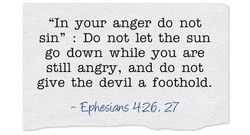
"Why can't you grow up?!" Parents sometimes express their anger and impatience with their children in this way. But, it is not a shameful thing to be a child. To acknowledge our child-like-ness is to acknowledge our limits and our dependency. It is to make room for wonder, trust and joy in our lives. If that is what it means to be a child, then we need more of it.

But there is also a sense, as in this text, in which to be child-like is to be immature or unstable. It is a good thing to grow-up. Not because it is shameful to be a child, but because growth is part of God's plan for us. Being "tossed back and forth" is an exhausting way to live. We need to find some way to live without being "blown here and there".

Growing up is hard work. The reason for this, as this text suggests, is that growing up is closely connected with learning to speak the truth. Honesty is a central dynamic of growth and recovery. Increasing our capacity for honesty is not an easy process. But, as we speak the truth in love, we will experience some dramatic changes in our relationships. We will find a more intimate relationship with God - we will 'grow up into Christ'. And we will also find ourselves 'joined and held together' in a community of faith.

Help me to be a child, Lord,
Help me to face my dependencies and my limits.
But, help me to grow up as well.
I'm tired of being tossed back and forth.
I want more stability than being blown here and there.
I want to have stable, healthy relationships
with you, and with others.
So, build within me a capacity for honesty.
Help me to speak the truth in love
so that I can grow up.


Amen.

Copyright Dale and Juanita Ryan

National Association for Christian Recovery


Picture
I am risen!  I did what I said I would do!  Here I am! I stand at the door and knock. If anyone hears my voice and opens the door, I will come in and eat with him and he with me.

Some people enter without knocking. It happens. Our boundaries have not always been respected. As a result, we have built some significant defenses. Our doors have multiple locks. When needed, they can be latched, barred, bolted, double bolted and sealed securely.

As we begin the healing process, however, we begin to experiment with allowing our defenses to come down. We unlatch one lock at a time.

Nothing is more helpful in this process than having people who respect our boundaries - people who will knock and wait patiently for an answer. So, this picture of Jesus is full of good news for us. Jesus stands at the door and knocks. It is pure invitation. God does not invade. God does not demand. God does not manipulate. God gently, persistently knocks. God says 'here I am, I would like to spend time with you'.

Recovery is a process of learning to trust God. Trust grows slowly. We can't do that all at once. But perhaps today we can listen carefully for a knock. Tomorrow we may be able to manage a "who is there?"  And, with persistence, we will some day sit at the table with God and enjoy His loving presence.

Lord, thank you for knocking.
Thank you for respecting my boundaries.
And, thank you for knocking persistently.
It takes me a while to respond 
because my doors have so many latches.
Give me courage this day 
to open the doors of my life to you. 


Amen.

Copyright Dale and Juanita Ryan
National Association for Christian Recovery


Picture
Come, all you who are thirsty, come to the waters; and you who have no money, come, buy and eat! Come, buy wine and milk without money and without cost. Why spend money on what is not bread, and your labor on what does not satisfy? Listen, listen to me, and eat what is good, and your soul will delight in the richest of fare. 

Most of us have spent a lot of money and a lot of effort on things that do not satisfy. When our efforts do not result in serenity, we become more and more confused and more and more frantic. Into the middle of this chaos and desperation comes an invitation. God invites us to receive 'food' which is designed to delight our souls.

God's invitation is to people who are thirsty or hungry. It is to people who are working hard but finding little satisfaction. The invitation extends to those who have no money or assets of any kind. God is not sparing or stingy. God is an extravagant giver of good things. God wants us to delight in the richest of fare.

The nourishment at God's feast does more than please our taste-buds. This meal is more than mere esthetic pleasure. The nourishment from God's table feeds our souls with delight. It is nourishment that sinks down to the deepest places of our being. God seeds delight in the foundations of our soul. And from these seeds come serenity, peace and the courage to continue.

God, I'm thirsty.
I have spent my money and energy
on things that have not satisfied.
God, my soul is hungry.
I need food for my soul.

Help me to come to you, Lord.
You know my hesitation.
You know how suspicious I am 
of such an extravagant invitation.
Help me to come as an eager child
to receive good things from you.
Feed my soul, Lord,
until it is full of delight.


Amen.

Copyright Dale and Juanita Ryan

National Association for Christian Recovery