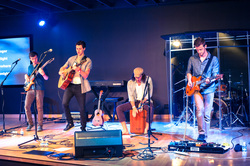
On a recent Sunday morning, I was having breakfast when I turned on my t.v. to watch a well-known local church’s broadcast. As I came to the right channel, I was greeted by the image of stage lights and a multi-piece band. Instead of what would normally be an opening praise song, the band started into the Bon Jovi 80′s classic, You Give Love a Bad Name. After the initial shock wore off, I double checked the channel I was on. Sure enough, this was the church service I was looking for. As the song finished, a member of the pastoral staff came out from behind the stage. After making a somewhat crude joke about hot flashes, he announced that the morning’s message would be on arguments in marriage. The staff member exited the stage while the band started into a worship song. With the band leading the church in two worship songs, I was left asking myself, “What in the world just happened?”
In a way, it is understandable what the church was trying to do. They wanted to get the congregation focused on the message by using a song containing the message’s theme. It is a common practice that many churches utilize today, traditional and contemporary alike. In either case, the music is tied in with the sermon topic to provide a theme for that day’s service. This method of planning worship services certainly has benefits, including the reinforcement of the sermon. However, there is an inherent danger in using this method every time a worship service is planned.
The TV broadcast mentioned above demonstrates an extreme in worship planning. This church is somewhat known for using secular songs related to the sermon as a call to worship. In this instance, they turned to a rock song whose lyrics speak of being hurt in a relationship. This song’s theme directly related to the sermon topic for that morning. While the very thought of a secular song being used in a worship gathering is enough to cause controversy in some circles, the danger this congregation is flirting with goes much deeper than the use of one song in a service. This church was so focused on reinforcing the message that, while externally polished, the intrinsic quality of worship was sacrificed. They did not make time for prayer in their service and placed little emphasis on Holy Communion.
People are intrinsically designed to connect with God on many levels. Scores of people have been impacted through the centuries by hearing powerful sermons and homilies. Additionally, innumerable hearts have been led into God’s presence through mighty hymns and contemporary worship songs. These hymns and songs have been the catalyst for outpourings of the heart onto God and have fostered many times of prayer. In worship, there must be a balance of what I call the Spoken Word and the Living Word. The Spoken Word is hearing a sermon/message/homily preached from the Scriptures and receiving from it. Some traditions would call this, “The Word Proclaimed.” The Living Word consists of coming to God in prayer, singing from the heart, and taking part in Holy Communion, e.g. the “hands-on” part of worship. This would be the more experiential part of worship where a congregation would be actively participating in the service.
A healthy church knows what it is to give equal weight to the Spoken and Living Word. A vital church also knows that there are instances when the Holy Spirit will direct that one be given more emphasis, e.g. more time, over the other. However, churches that consistently give one more priority over the other run the risk of not only robbing their members of a full worship experience in the presence of God but also presenting an incomplete picture of Christian worship to unbelievers. The fact that we believe in and worship a God that is alive is what separates us as believers from other world religions. How we worship our Lord communicates to the world what we believe. A church that has unbalanced worship conveys its lack of spiritual depth, and no matter how flashy we try to be in our church services, unbelievers are not as spiritually and intuitively naïve as we sometimes think they are. They can tell when something is not right within the church walls, and they will run from it. People are looking for something more than another message to tickle their ears. They want something that is real and that they can experience for themselves. A church that focuses only on its sermons robs people of additional ways to encounter the Living God and also robs God of other ways to speak to people. Going back to the church mentioned above, their use of a secular song at the beginning of their service took time away from the opportunities to commune with God through prayer or worship music. Because they desired to emphasize the Spoken Word, the Living Word suffered by having reduced time.
Let me conclude by posing this: what is the first question you ask when you plan worship? Is it, “What is the sermon about this week?” Are all aspects of the worship service being consistently and intentionally united with that week’s sermon topic? Are the prayers prewritten to match the message? Are all the opening and closing hymns/praise songs being chosen simply because the title/lyrics relate to the sermon? Or is the first question asked, “Lord, how should we worship you this week?” Is substantial time being spent in prayer over what hymns/songs to use? Is there a time of spontaneous prayer set aside to allow the Holy Spirit to direct the hearts of those in attendance? Your congregation, and even the entire world, depends on the first question asked in worship planning and how it is answered. May we all have the spiritual sensitivity and courage to ask the right question and follow the Lord in our worship no matter where He may lead.This post was written by Chase Franklin of Seedbed. For the original post with comments, go to: http://seedbed.com/feed/unbalanced-worship-overemphasizing-the-sermon/BE HOLY.BE A MAN.
Picking worship songs for your church or worship gathering is an important task. In a previous post, I argued that we need to start to think about how we choose songs with a long-term vision of what happens when we gather together. The things we sing shape how we view God and what it means to live as the people of God. Our song choices need to function more like a grammar for the faith and less like sacred karaoke; choosing better songs will hopefully lead to a people who are better shaped by and better proclaim the good news of Jesus Christ.
So how do we pick better songs? Or how do we know if a new song is worth singing together? Today, I want to offer one of the questions I use to filter out what is better from what may not be: Who is doing what in this song? I know- what horrible phrasing and what an awkward question, right? Well, this is how I start to think about something grammatical people call agency. When studying the grammar of a sentence, the agent is the initiator of the action of the phrase or sentence. Agency is about who is doing what is being done in a text. Where there are verbs, there is agency, for every doing is linked to a do-er.
Let’s take a fairly popular worship song and look at agency in its lyrics. In Tim Hughes’ “Here I Am To Worship,” the opening line of the chorus reads:
Here I am to worship, Here I am to bow down, Here I am to say that You’re my God.
In these lines, the agent is the “I” who is singing. “I” am the one who is acting, who is worshipping, bowing down, and saying what I then say. Similarly, in the first verse:
Light of the world, You stepped out into darkness- Opened my eyes, Set me free.
The agent who stepped out, opened and set “me” free is God, or more specifically Christ, as these lyrics reference the Incarnation. There are many songs that we sing in churches that name who God is or who we are (we call those stative verbs), but even stative verbs have agency: If you claim, “Jesus is Lord”, the verb is still referring to Jesus (the agent) who is in a state of Lordship. So every song we sing has verbs in them, and the verbs point to the do-ers of the actions they name.
What does this grammar talk have to do with picking worship songs? Stick with me…
The gospel, or good news, of Jesus Christ centers on the actions that God took to bring salvation to us all. Paul calls the gospel, “the power of God for salvation to everyone who believes” (Rom 1:16). The Father sends the Son, in the power of the Spirit, and the Son willingly lays his life down to atone for our sin, is raised, ascends, and will return to redeem his people and the entire creation (a brief synopsis, I know). Notice how all of the verbs in the gospel have God as their agent. Why? Because he is the author and perfecter of our faith. He has acted, and we respond to his grace by his grace.
With this in mind, I firmly believe that songs that lean more on God as the agent in their lyrics are better for the church because they better reflect the agency we find in the gospel. When you listen to a new song and it is more about what I or we are doing than what Christ has done/is doing/will do, the song should seem off-balance in light of the agency of the good news. There is definitely a place for songs and lines of response (and I will talk about that soon), but as worship leaders whose song choices shape the thoughts and hearts of those who join us in song, we must first and primarily name who God is and what God has done, for in God and his actions we find the power of God for salvation to everyone who believes, and that includes the people singing in our church.
So when you listen to that new Cool Guy Worship Collective album, pay attention to the verbs. Who is the primary do-er in this song? Who is acting, and what actions are being named? Live by this rule when choosing songs: a song with heavy God-agency will always be healthier for your church than a song with heavy us-agency. The more the saving actions of God are named, the more likely the song will shape your church into the redeemed people the good news redeems by the power of the Spirit.
This post was written by Drew Causey. For the original post with comments, go to: http://exchangedliving.com/post/48779369196/picking-worship-songs-101-gods-love-my-loveBE HOLY.BE A MAN.
I’m a member of Alaska’s largest church. It’s a lot like every other megachurch. We meet in a cavernous, windowless room with stage lighting and two huge projection screens. We’re led by a rock band and a casually dressed pastor. The service lasts exactly 75 minutes. Our church draws a large crowd that attends sporadically. There’s a relatively small, highly committed core of members that keeps the machine going.
I like my church. But it’s in Anchorage, 26 miles from my house. So my wife and I occasionally worship at a small traditional church in our little town of Chugiak. (Let’s call it St. Mark’s)
We’ve been enjoying our Sundays at St. Mark’s. The richness and rigor of the liturgy is refreshing after years of seeker-sensitive services. It’s an eight-course meal, carefully measured out for us by church fathers – confession, forgiveness, praise, instruction, communion, giving, fellowship and benediction. It’s like a spiritual multivitamin in an easy-to-swallow, hour-long pill.
St. Mark’s has a lot going for it. The people are friendly, but not overly so. There is a healthy number of kids and young adults. The facility is well kept. The sermons are insightful. We love the depth of the hymns – and the people sing robustly (as opposed to most megachurches where very few people sing). It takes my wife back to the 100-member churches of her youth.
But last Sunday was different. Once a month, this little church does a contemporary service. Gina and I were surprised – unpleasantly so.
We arrived to find the pastor without his clerical robe. A projection screen had been lowered in front of the organ pipes. We sang praise choruses instead of hymns, led by a solo guitarist who had trouble keeping the beat. The congregation did not seem to know the songs, so they sang tentatively. On a positive note, the sermon was good as usual, and the pastor skillfully used PowerPoint slides to reinforce his message.
But on balance, the overall quality of the service was not up to par. Had this been our first Sunday at St. Mark’s it’s unlikely we would have returned.
So what went wrong? This little church was trying to be something it’s not.
St. Mark’s is a traditional church. And it’s very good at being a traditional church. But it’s a lousy contemporary church.
It’s an article of faith these days that contemporary worship is the way to go if you want your church to grow. Thousands of churches will be planted this year – and every one will offer contemporary worship. Hymns are out – love songs to Jesus are in.
Traditional churches have seen young believers flocking to megachurches, so naturally they want to get in on the growth. But this is foolish. Traditional churches lack the musical depth, computer controlled lighting and sound equipment that are needed to generate the “praise-gasm” that young believers associate with God. Rock music seems out of place in a brightly lit chapel a communion table and stained glass.
People come to church to encounter God. A good worship service is transcendent; it helps people detach from this present world to connect with the divine. But when traditional churches try to be contemporary it usually comes across as forced, stilted or artificial. This dissonance jerks people back into the mundane world. Worshippers focus on the distraction instead of the Lord.
So here’s my advice to every church: be who you are. Do what you do well – and do it over and over. If you want to innovate, do so within the bounds of your culture.
Radio stations understand this princple. You won’t find the local pop music station playing the occasional Beethoven concerto. Nor will the country music station spin Lil’ Wayne’s latest rap record. Our local “Mix” radio station plays a variety of songs – but they’re all within the same genre – familiar pop/rock hits of the past 30 years.
If your church is big enough to offer two services, it might make sense to designate one a “traditional service” and the other a “contemporary one.” But if you offer just one service, stick with what you do best.
What has this got to do with men? Guys appreciate a quality worship service — but they are not very forgiving of anything hokey or half-baked. If guys want contemporary worship, they’ll go to a megachurch. Meanwhile, I firmly believe there’s still a market for traditional worship — even among the young — if it’s done in Spirit and in Truth.This post was written by David Murrow. For the original post, go to: http://www.patheos.com/blogs/afewgrownmen/2013/04/why-traditional-churches-should-stick-with-traditional-worship/ BE HOLY.BE A MAN.
It happened again yesterday. I attended one of those hip, contemporary churches — and almost no one sang. Worshippers stood obediently as the band rocked out, the smoke machine belched and lights flashed. Lyrics were projected on the screen, but almost no one sang them. A few women were trying, but I saw only one male (other than the worship leader) making the attempt.
Last month I blogged, “Have Christians Stopped Singing?” I did some research, and learned that congregational singing has ebbed and flowed over the centuries. It reached a high tide when I was a young man – but that tide may be going out again. And that could be bad news for men.
First, a very quick history of congregational singing.
Before the Reformation, laypersons were not allowed to sing in church. Sacred music was performed by professionals (priests and cantors), played on complex instruments (pipe organs), and sung in an obscure language (Latin).
Reformers gave worship back to the people, in the form of congregational singing. They composed simple tunes with lyrics that people could easily memorize. Some of the tunes came out of local taverns.
A technological advance – the printing press – led to an explosion of congregational singing. The first hymnal was printed in 1532, and soon a few dozen hymns became standards across Christendom. Hymnals slowly grew over the next four centuries. By the mid 20th century every Protestant church had a hymnal of about 1000 songs, 250 of which were regularly sung. In the church of my youth, everyone picked up a hymnal and sang every verse of every song.
About a decade ago, a new technological advance – the computer controlled projection screen – entered America’s sanctuaries. Suddenly churches could project song lyrics for all to see. Hymnals became obsolete. No longer were Christians limited to 1,000 songs handed down by our elders.
At first, churches simply projected the songs everyone knew – hymns and a few simple praise songs that had come out of the Jesus Movement. People sang robustly.
But that began to change about three years ago. Worship leaders brought in new songs each week. They drew from the radio, the Internet, and Worship conferences. Some began composing their own songs, performing them during worship, and selling them on CD after church.
Years ago, worship leaders used to prepare their flocks when introducing a new song. “We’re going to do a new song for you now. We’ll go through it twice, and then we invite you to join in.”
That kind of coaching is rare today. Songs get switched out so frequently today that it’s impossible to learn them. People can’t sing songs they’ve never heard. And with no musical notes to follow, how is a person supposed to pick up the tune?
And so the church has returned to the 14th century. Worshippers stand mute as professional-caliber musicians play complex instruments, and sing in an obscure language. Martin Luther is turning over in his grave.
What does this mean for men? On the positive side, men no longer feel pressure to sing in church. Men who are poor readers or poor singers no longer have to fumble through hymnals, sing archaic lyrics or read a musical staff.
But the negatives are huge. Men are doers, and singing was one of the things we used to do together in church. It was a chance to participate. Now, with congregational singing going away, and communion no longer a weekly ordinance, there’s only one avenue left for men to participate in the service – the offering. Is this really the message we want to send to men?Sit there, be quiet, and enjoy the show. And don’t forget to give us money.
There’s nothing wrong with professionalism and quality in church music.The problem isn’t the rock band, or the lights, or the smoke machine. The key here is familiarity. When that super-hip band performed a hymn, the crowd responded. People sang. Even the men.
This post was written by David Murrow. You can find the original post here: http://churchformen.com/how-were-off-the-mark/why-men-have-stopped-singing-in-church/ BE HOLY. BE A MAN.
Baltimore (CNN) - The capacity crowd at the 1st Mariner Arena in Baltimore is bouncing in unison to the most widely sung music on the planet today. The catwalk above the arena is shaking. Chris Tomlin grabs the microphone and asks the crowd if they’re ready. "I feel alive, on God's great dance floor!" He leads the packed venue in singing and jumping. Tomlin is out touring the country with his latest studio album, “Burning Lights.” In January, it topped the Billboard 200 charts. But unlike those who've enjoyed performances by Beyonce, Johnny Cash and a host of others who've played this Baltimore hall, after these fans stream out the doors they will have ample opportunity to sing Tomlin's songs again, as one. That is the secret to Tomlin’s success – the stage, the lights, the band - aren’t about him. As lively as his shows are, the point is not to get you inside the doors. The point is to get you singing in church. “I strive for trying to write something that people can sing, that people want to sing, and that people need to sing,” Tomlin explained before the show. Tomlin is the undisputed king of worship music, a genre of Christian music sung on Sunday mornings all across the world and increasingly played on Christian radio stations. The music is simple, devotional and easy on the ears. “We would say that Chris is the most prolific songwriter in the United States now, in this past decade,” said Howard Rachinski, CEO of Christian Copyright Licensing International, the company that tracks what music is used in churches around the world. In 2012, CCLI paid out $40 million to artists and musicians, and Tomlin got a healthy slice of that pie. Churches around the world used 128 songs he wrote or co-wrote last year, Rachinski said. CCLI estimates that every Sunday in the United States, between 60,000 and 120,000 churches are singing Tomlin’s songs. By extrapolating that data, Rachinski says, “our best guess would be in the United States on any given Sunday, 20 to 30 million people would be singing Chris Tomlin's songs.” In their last two reporting periods, Tomlin had the No. 1 most-sung song and five of the top 25. Search YouTube for "How Great is Our God" or "Amazing Grace (My Chains Are Gone)." Black, white, Asian, big churches, small ones are all belting out Tomlin songs. A lot. For perspective, consider Tomlin’s musical success against one secular counterpart. In 2012, Katy Perry's record sales dwarfed Tomlin’s, but Billboard reported her songs were played 1.4 million times on the radio. Using CCLI’s low-end calculation, Tomlin’s songs were played 3.12 million times in churches. Chris Tomlin was reared in Grand Saline, Texas, heavily influenced by country music. His dad taught him to play the guitar. “I learned all country music - Willie Nelson, and Johnny Cash, all those kind of guys. Those are what my dad played and I played. And I played at my church as well,” Tomlin said. Tomlin went to college to study sports medicine. “I just didn't know the music would take me here. I loved it and I was getting opportunities to go play, and when I say go play I was starting to write songs of worship even (as) a young kid. I didn't know really what worship music was, what a worship leader was, any of that. I didn't know any of those terms,” he said. Today, at 40 years old, he is the artist most associated with worship music. While in college he began singing and writing in earnest. As a senior, he said, he was getting invitations to lead the music for Christian conferences with 10,000 students. He knew his music was resonating with crowds when he got a call from EMI Publishing after his song “We Fall Down,” which was released in 1998, starting being played in churches. “I was just writing songs for the church and from there they just started taking off.” The compositions are considerably different from pop music. They are simpler, and he takes pains to write them that way. “I'm thinking as that comes out of my heart as a song of response, I'm trying to think, how can I form this so that everybody, people who are tone deaf, who can't clap on two and four, how can I form this song so they can sing it, so that it is singable?” Part of that process comes from his love of country music, the simplicity of that music and the stories those songs tell. His goal is to write songs that communicate what people would like to say to God. “Now, that doesn't happen all the time. I mean, I write so many songs that you never hear because they are not any good.” Tomlin is the worship pastor at Passion City Church in Atlanta. He leads worship there twice a month and beta tests all his new songs on the congregation. Tomlin is also a major draw as the worship leader of the Passion Conferences, a series of Christian conferences around the world. In January, the conference packed out the Georgia Dome in Atlanta with 60,000 college-age students. Billboard magazine noted the conference helped push up pre-sales of Tomlin’s latest CD. His songs are so sought-after that, even before they're released on CD, they start showing up in CCLI’s online database. “His songs have probably had the most immediate impact on churches that we have seen in history,” Rachinski said. “Even before you get to street release [of a CD], churches are already networked and engaged with his songs.” Other contemporary Christian musicians, as the music industry designates them, have crossed over to mainstream pop with some success. Tomlin said he has no designs on making that leap. He also doesn’t need the money. Over the course of his career he’s sold 4.2 million albums, had 6 million digital downloads, a number of sold-out tours, and of course, the copyright royalties. Tomlin said money isn't what motivates him to write and perform. “I feel like I have a responsibility, that God has given me a gift to write songs for his church that people listen to and that people are coming to expect now,” he said. “When I make a record I feel that responsibility that worship leaders, churches are going to say, 'Hey, are these some new songs we can sing in our church?' And I don't take that lightly, and I don't go, ‘Oh let's go do something else fun.’” “I haven't invented any new instruments, I haven't created new chords that no one has ever played. I play the same chord that every band plays, we play the same instruments up there, the melodies are melodies. The difference to me in the music is that I ask that God's presence be on it and that people, when they sing these songs, sense that God does something.” The spotlight is on Tomlin even more than ever after starting the year a top the Billboard charts. As he tours the country at bigger and bigger venues, he would prefer to step out of the spotlight, away from the microphone, and let everyone else sing. “People would be mad that they paid for a ticket for that. So I do that just occasionally, but that is what I love.” He said the night before, at the Theater at Madison Square Garden, he took as much time as he could to step back and let everyone else sing. “It was just so beautiful, because I feel like it says something. It's not just like, ‘Hey, listen to me sing.’ This is all of us together. I think when you step back from the mic and it is not about you - and yeah, the light may be on you, but this is about all of us singing. This is about a bigger story, it's about a greater story. It's about a greater name than my name. My name is on the ticket, but this is about a greater name.” CNN's Oliver Janney, Chris Turner, and Dan Merica contributed to this post. For the original post, go to: http://religion.blogs.cnn.com/2013/03/09/the-most-sung-artist-on-the-planet/BE HOLY. BE A MAN
I have a confession to make. I may be in the vast minority, but it is true that I do not listen to much music. Don’t get me wrong…if I were to listen to something on the radio or on an mp3 player, I would have certain preferences, but for the most part, I prefer not to listen to music. It’s not that I dislike the sound, or can’t appreciate the art, because the artistic expression is obvious. People spend a lot of time, energy, and money honing their craft for the purpose of entertaining and expressing their deepest emotions through the vehicle of music. I appreciate that fact. I just don’t find much joy in listening to music for long periods of time. I want to make it known that I believe God created music for our pleasure and also as a mechanism for worship of Him. It can give us such joy and it also pleases Him if we use it to serve. In today’s culture, music has become the most popular way people have chosen to interpret what they are feeling. For some, it has also become an unhealthy distraction to a life that needs certain issues addressed. People will describe their anguish or love through lyrics that bring them to tears. When walking down the street in the middle of a crowded city, it would be difficult not to pass someone wearing a shirt representing a band, listening to their favorite songs, or even playing an instrument for extra cash. The problem with music is the way it has been misused in our culture. People seem to be genuinely afraid of silence. This could be that the thoughts that they would be alone with are ones they do not want to confront. No matter the reason, silence makes us uncomfortable. Today, take some time to be silent. Don’t read. Don’t speak. Don’t listen to music. Just be alone and silent. Ask God to whisper to you during this time. You will be amazed what can come from being uncomfortable and deliberate. This post was written by Rev DeCrastos. For the original post, go to: http://other-words.net/2013/01/27/the-key-of-silence/BE HOLY.BE A MAN.
A new mainstream country artist is stirring controversy with a radio single and music video that imagines what it would be like to spend time social drinking with the Son of God. Thomas Rhett, son of singer-songwriter Rhett Atkins and a newcomer to the country music scene, says that he penned the song “Beer With Jesus” three years ago to put into words what he would ask Jesus if he were able to sit down at a bar with Him. “If I could have a beer with Jesus, Heaven knows I’d sip it nice and slow,” the song begins. “I’d try to pick a place that ain’t too crowded, or gladly go wherever He wants to go. You can bet I’d order up a couple tall ones; tell the waitress put ‘em on my tab.” “I’d be sure to let him do the talkin’, careful when I got the chance to ask. How’d you turn the other cheek to save a sorry soul like me?” the song continues. “I’d tell everyone, but no one would believe it, if I could have a beer with Jesus.” Rhett, who grew up Valdosta, Georgia and now resides in Nashville, Tennessee, says that he was brought up in the church, but that his beliefs about the subject of alcohol have changed over time. “I grew up Church of Christ,” he told Taste of Country. “You’re taught that beer is wrong and alcohol is wrong.” “When I got to college, some of my beliefs kind of changed, and that’s just a song that I personally believe that’s how Jesus would have been if he were here,” Rhett explained. “That song means so much to me and to my family.” Rhett, 22, said that he has had some of his deepest conversations with friends while drinking alcohol. “Those moments stick out in my mind because those were some of the best conversations I had with my buddies … just getting below the surface and talking about deeper life stuff and things that matter,” he states. “Beer with Jesus,” co-written by Rhett, Lance Miller and Rick Huckaby, was crafted to outline what the songwriters believe most listeners would want to ask the Lord, according to Rhett. “[W]e tried to make very broad questions about what we would ask Jesus and what we thought the general population would ask Jesus if they had 20 minutes just to sit down and talk to Him,” he outlined. Questions in the song include “Is Heaven really just beyond the stars?” “What’s on the other side?” and “Are Mom and Daddy alright?” “He can probably only stay for just a couple rounds, but I hope and pray He’s stayin’ till we shut the whole place down,” Rhett sings. Reactions to the song, which is now playing on country stations nationwide, and is also featured in a music video on CMT, have been mixed. “Every time I play that song live, a lot of people will cry,” Rhett told GAC-TV. “I’ve had a preacher come up to me saying, ‘Man, I would love to get you up to Wisconsin and sing that song at our church service.’” “A woman called into a radio station in Pennsylvania a couple weeks ago and voiced that her son had just been killed in a car accident,” he continued. “And she came to my show in Pennsylvania and told me that her son’s five best friends were at the funeral, and they played my song ‘Beer with Jesus’ and they all got baptized because of the song and what it did to them.” However, Julia Conner with country radio station US105 admits that not everyone is thrilled about the song. “Of course there is controversy,” she states. “[S]ome folks don’t feel Jesus would be drinking beer, and we ought not sing about it.” Some listeners across the country agree. “Why not just have some water with Jesus? This is a prime example of how far down the toilet country music has gotten,” writes commenter Marshall Chandler. “If you want to sing about Jesus, do it. … Just don’t mix the two!” For the original post, go to: http://christiannews.net/2012/12/13/mainstream-country-artists-beer-with-jesus-radio-single-and-music-video-stirring-controversy/Tomorrow, we will discuss another view of Jesus and bars... BE HOLY. BE A MAN.
Rise up, O men of God! Have done with lesser things. Give heart and mind and soul and strength to serve the King of kings.
Rise up, O men of God! The kingdom tarries long. Bring in the day of brotherhood and end the night of wrong.
Rise up, O men of God! The church for you doth wait, her strength unequal to her task; rise up, and make her great!
Lift high the cross of Christ! Tread where his feet have trod. As brothers of the Son of Man, Rise up, O men of God!
Text: William P. Merrill, 1867-1954 Music: William H. Walter, 1825-1893
BE HOLY. BE A MAN.
Even though this is Canadian research, there is much here that applies to the American church. Why are there so few men in the average Canadian congregation? Early in 2009, the women elders at Strathcona Baptist Church in Edmonton suggested that the congregation adopt as a key objective over the next few months “That 50 percent of our church attendees should be men.” Bob Goethe, also serving as an elder, took the opportunity to purchase David Murrow’s book, Why Men Hate Going to Church (Thomas Nelson, 2004; related website www.churchformen.com). He gave each elder a copy of this book. Goethe asked them to read 42 pages in the book and answer three broad questions. On the evening they met for discussion, they went over their general responses to the book, and then looked at a worksheet and evaluated several songs by their lyrics. They used a scale to rate songs as to whether they appealed primarily to men or women. The theory here is that on any given Sunday, if you add up the numbers of the “F” (feminine) songs and the numbers of the “M” (masculine) songs, they should come out roughly even. Here are some of the results of the Strathcona Baptist experiment: One song (author unknown), based on Psalm 125:1-2, got an average rank of M2. The elders chose that because of the imagery of Mt. Zion, of bigness, of power. Some lyrics: “Those who trust, those who trust / Those who trust in the Lord / Those who trust in the Lord are as Mount Zion / which cannot be moved but remains established forever.” The song “Lord, you are more precious than silver” (by Lynn DeShazo, 1982, a setting of Proverbs 3:14-15) rated an F8, which the elders decided is too feminized to be sung in a worship setting. The women elders were actually harder on this song than the men. Calling Jesus “precious” and “beautiful” made it a feminine song. And the line “nothing I desire compares with you” made it strongly feminine, since such language is so associated with romantic love. Some lyrics: “Lord, you are more precious than silver / Lord, you are more costly than gold / Lord you are more beautiful than diamonds / And nothing I desire compares with you.” The elders came to agree that feminine worship songs tend towards celebrating a passionate love affair with Jesus, while masculine worship songs are more about strength, power, commitment and loyalty. Participants decided to implement a balance of songs based on their scale to see if there would be any effects. Goethe reports that they have been very positive, even striking. Before opening the issue, Goethe counted about 40 percent men in Sunday morning services. Whenever the worship team used to invite worshippers to “take a few moments to speak out our praises to God,” the voices one heard were almost all women’s voices. The men had nothing to say during these times of corporate worship. They began discussing Murrow’s book and analyzing worship songs in March 2009, and started making immediate, small changes in the mix of worship songs, eliminating songs that were F6 to F10s, and trying to make sure there was a balance of masculine- and feminine-flavoured worship every week. After they got into this process, one of Goethe’s male friends said to him: “This is great. It helps me to understand perhaps why I have often found it hard to ‘enter into worship’ – something I usually attributed to be just being ‘less spiritual’ than those around me.” Only six weeks after they began making intentional changes, when a worship leader called on people to speak out their praises to God, half of the voices were male. It seems men are finding it a bit easier to track with the worship times and engage with the Holy Spirit. After six months, overall attendance had grown, and fully half of those who attended were men. The elders have taken the “50 percent men” goal off the To-Do list and put it on the Done list. Admittedly this subject and this method are controversial and easily misunderstood. No one should think that leading worship at church is an easy task for anyone, male or female. But let’s not be afraid to open up a conversation that will allow us all to begin to think seriously about the words of the songs that we are trying to get men to sing on Sundays. If that can help deal with one of the issues that keep men out of church, we might be able to attack some of the others. This research is taken from: http://www.christianity.ca/NetCommunity/Page.aspx?pid=7243
New favorite song by Tenth Avenue North. The title is LOSING. Terrific truth and honesty and the composition is just riveting. Here are the lyrics: I can't believe what she said I can't believe what he did Oh, don't they know it's wrong? Don't they know it's wrong? Well maybe there's something I missed But how could they treat me like this? It's wearing out my heart The way they disregard This is love. This is hate. We all have a choice to make Oh, Father won't You forgive them? They don't know what they've been doin' (oh no) Oh, Father, give me grace to forgive them Cause I feel like the one losin' It's only the dead that can live But still I wrestle with this To lose the pain that's mine Seventy times seven times Lord it doesn't feel right For me to turn a blind eye But I guess it's not that much When I think of what You've done. This is love. This is hate. We've got a choice to make Oh, Father, won't You forgive them? They don't know what they've been doin' Oh, Father, give me grace to forgive them Cause I feel like the one losin' (oh no) Why do we think that hate's gonna change their heart? We're up in arms over wars that don't need to be fought But pride won't let us lay our weapons on the ground We build our bridges up, but just to burn them down We think pain is owed apologies and them it'll stop But truth be told it doesn't matter if they're sorry or not Freedom comes when we surrender to the sound Of Mercy and Your Grace, Father, send Your angels down (singin') Oh, Father, won't you forgive them? They don't know what they've been doing (oh, no) Oh, Father, give me grace to forgive them Cause I feel like the one losing I feel like I've been losing Oh Father won't you forgive them? They don't know what they've been doin' Oh Father, give me grace to forgive them Cause I feel like the one losin' I feel like I've been losing Oh, Father, give me grace to forgive them Cause I feel like the one losin' http://www.lyricsmode.com/lyrics/t/tenth_avenue_north/#share
|